Why Is Trucking Still Buried in Paperwork?
Listen to this story on the Keep the Shiny Side Up! podcast, Episode 11
Also on Apple Podcasts, Amazon Music, YouTube, iHeartRadio and Pandora. See all episodes
This post started with a question from one of our readers. Armando Galvan reached out on Facebook and asked why something as simple as an electronic bill of lading still hasn’t caught on in trucking, when it would make life so much easier for small carriers like us. Armando, thank you. It’s a great question, and it turned into both this post and Episode 11 of our podcast, Keep the Shiny Side Up!
So let’s talk about paperwork: how much of it truckers really deal with, why the industry has been so slow to go digital, what could speed it up, and where technology is already making life easier.
My worst paperwork memory
When I was still pretty new, we ran Walmart dedicated, hauling from cold storage warehouses out to their stores. Each load carried freight for two to five stores.
At every store, you backed into the dock, then walked around to the door. It was always locked, and half the time nobody was around to let you in. Once you got inside, every single pallet had a bar code sticker, and as the truck was unloaded, I had to be right there on the dock peeling off every sticker and putting it on my paperwork.
Those stickers were usually stuck to the shrink wrap and did not want to come off. With a couple of people unloading at once, I’d be running from pallet to pallet, trying to grab the sticker before that pallet disappeared into the store, and holding up the whole process. Then I’d do it all again at the next store. Back at the warehouse, I’d drop the trailer, walk into the office and hand over the whole stack of paper.
It was a true nightmare. I’m pretty sure it doesn’t work that way anymore, but every one of those stickers was information a computer could have just scanned.
What the paperwork on a normal load looks like
- The bill of lading (BOL). The main shipping document: what’s on the truck, how much, where it’s going and who’s responsible for it. Usually the shipper provides it.
- The carrier’s own paperwork. Many trucking companies have their own forms on top of the shipper’s BOL.
- Signatures at both ends. The driver gets paperwork signed at the shipper on pickup and again at the receiver on delivery. That delivery signature is the proof the job was done and the freight arrived in good shape.
- Scan and upload. After delivery, everything gets scanned and uploaded so the load can be closed out and billed.
Not long ago, step four meant finding a truck stop with a scanning station and feeding pages through one at a time. Today, apps like Transflo let drivers snap a photo and send it from their phone. That saves a lot of time and walking. But notice what didn’t change: it’s still paper. We just take a picture of it now.
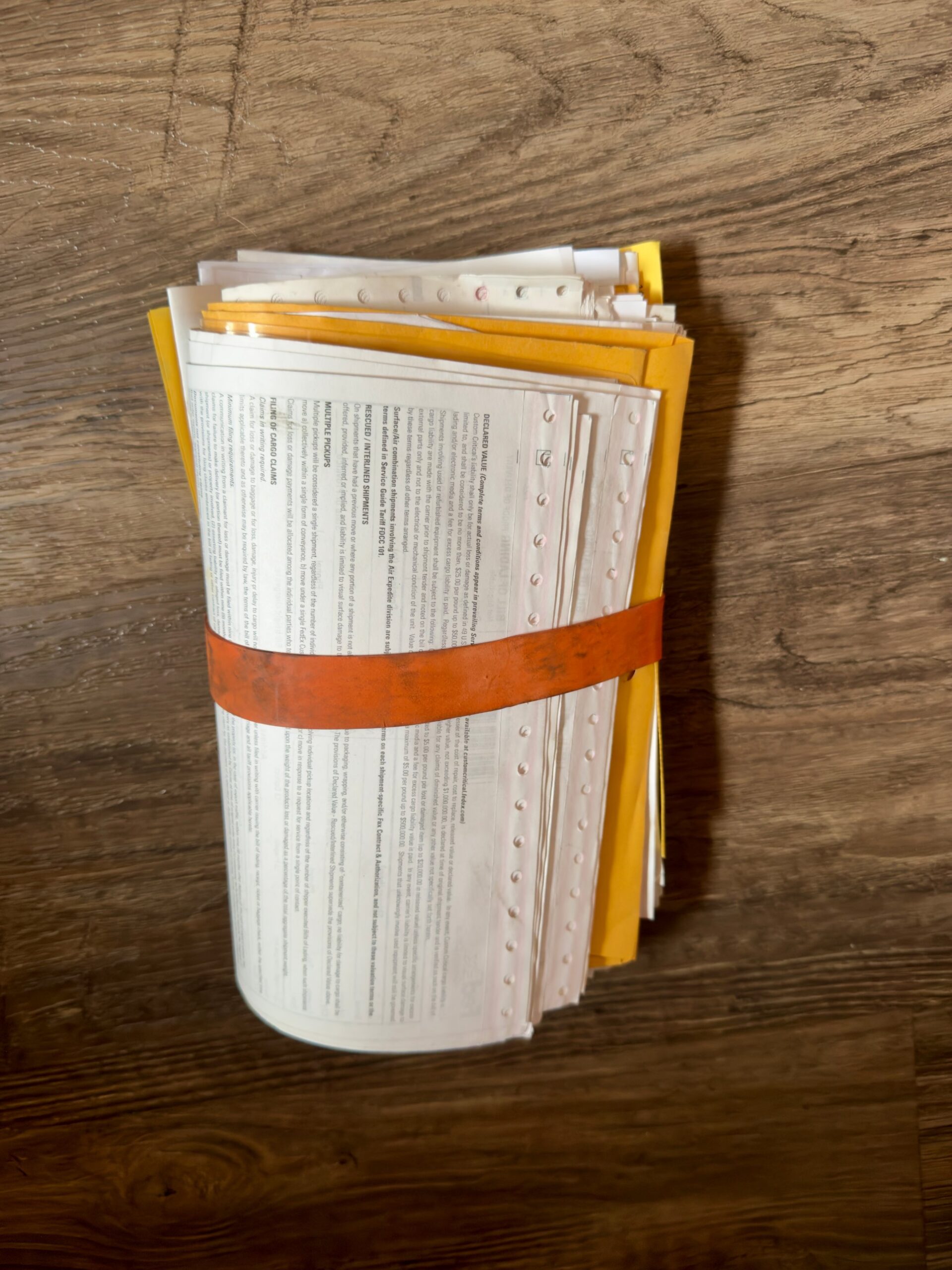
And even after it’s uploaded, you’re not done with it. Drivers hang on to that paper for three to six months, just in case something got missed. I just got a bundle back from one of our drivers when his truck went in for its new ELD install. That’s it in the photo at the top of this post.
Why is the electronic bill of lading so slow to catch on?
Parts of the industry are moving. Less-than-truckload (LTL) carriers, which combine freight from many shippers on one trailer, agreed on a standard electronic bill of lading format for the first time in their 100-year history, and big brokers like C.H. Robinson have adopted it.
It makes sense that LTL went first. I’ve never hauled traditional LTL myself, but one LTL trailer can carry freight from dozens of shippers headed to dozens of places. That’s a mountain of paperwork on a single truck, and when it hurts that much, you fix it first.
Full truckload, the kind of freight most of us haul, only just got its first standard electronic format. For a lot of carriers, it’s barely out of the starting gate. And it isn’t just trucking: ocean shipping lines are going through the same change, with only about one in ten container bills of lading electronic and the biggest lines promising to go all the way by 2030.
Think about that. We can move 45,000 pounds of freight from one coast to the other in two days, but the technology for the paperwork could take years to catch up to yesterday. Here’s why I think that is.
1. The scale house
When a truck rolls through a weigh station, the officer can ask to see the paperwork. The driver has to be able to show what’s on that truck, right then. Until the rules and the inspectors fully accept a screen, everybody keeps printing paper just in case.
Hazmat is the clearest example. The federal agency over hazardous materials has been considering electronic shipping papers since at least 2009, and the major trucking associations asked it to move in 2020. The paper still rides in the truck. This year, carriers were finally allowed to keep one hazmat document, the registration, in electronic form. The government is moving, one piece of paper at a time.
2. Nobody’s on the same system
Every shipper, broker and carrier has its own software, and many of them don’t talk to each other. A big company can tell its partners to use its system. A small carrier doesn’t get a vote; we use whatever the shipper hands us.
3. Change is hard, and truckers are people
One of our drivers is an absolute beast on the road. Rain, snow, tight docks, it doesn’t matter. But hand him a new screen and it’s a different story.
FedEx is switching the ELDs (electronic logging devices) in our trucks from Omnitracs to Motive. His was switched over recently, and I’m still crossing my fingers that he’s made it through okay. Once he gets used to it, the new one is so much better and easier. It isn’t the technology that worries me. It’s the change.
The new system also finally got rid of macros. On older ELDs, a macro was how you sent information to the office: pick a canned message on the screen, fill in the blanks, send it. Loaded, empty, arrived, delayed. Macros were really the first step of truck paperwork going digital, and they did the job for a long time, but they were clunky and hung around way too long. With Motive, they’re gone. Finally!
I think that’s most of this industry. A lot of drivers have done it the paper way for twenty plus years, and the paper way works. When a new app freezes at a shipper at two in the morning, there’s nobody to call. Paper doesn’t freeze.
What could speed it up
- Let the officer at the scale accept the screen. If regulators and inspectors fully accept electronic documents, a huge reason to keep paper goes away.
- One standard everyone uses. It doesn’t have to be the same app. Every company can keep its own software, as long as the format and the way information is passed back and forth are the same for the shipper, carrier, broker and receiver.
- Build it into the apps drivers already have. Even some eBOL companies say drivers don’t need one more app on their phone. Put it in the ELD or the tools they use every day.
- Make it simple, and train people. Big buttons, few steps, a real person to call when it doesn’t work, and patience for drivers who’ve done it the paper way for twenty plus years.
- Big shippers lead. Small carriers can’t force anyone to change, but when the biggest shippers and brokers go electronic, everybody else follows.
The payoff is real. Remember my stickers? With the new LTL electronic bills of lading, drivers no longer have to carry books of stickers to tag the paperwork and every pallet. Somewhere out there, a driver isn’t peeling stickers off shrink wrap today, and I’m really happy for them.
Where technology is already helping
The DOT medical card
For years, a commercial driver’s DOT physical meant a paper medical card. You had to hand-carry it to the DMV yourself and keep it on you in the truck in case an officer asked. If you forgot to drop it off, or the DMV lost it, your license could be in trouble.
Now it’s going electronic. After the physical, the medical examiner uploads the results to the FMCSA’s National Registry, which passes them to your state for your driving record.
Tip: before you leave the doctor’s office, ask them to confirm they’re uploading your results. Some drivers have found out weeks later that it never got sent. And keep your paper copy for now, since not every state has finished the switch.
Our truck book goes digital
Every truck has to carry certain documents by law: registration, insurance, permits and more. For years, I made a three-ring binder for each of our trucks, with the required documents plus examples of how to fill out a BOL and instructions for uploading paperwork.
The trouble is, those documents expire at different times, so something always needs a fresh printout. Very few drivers can print on the road. And because the binder is almost never needed, it gets stuffed into a crevice in the truck and forgotten.
So we’re moving everything to eTruckBook, an app our drivers have on their phones. When something expires, I update it once and every truck has the new version. We printed only the most important items and swapped the binder for a single plastic sleeve. So far the drivers have been quiet about it, probably because nobody has asked them for anything in that book yet. The first time an officer asks and it’s right there and easy, I expect I’ll hear about it.
Our driver app
We’re also building our own Miles 2 Go Transport driver app to pull all of this together. Drivers will be able to request home time, pull up the truck book, and watch short step-by-step videos on things like the new ELD, navigation and fuel stops. Less paper, less hassle, and more time for our drivers to do what they do best.
ShiftSeat
We’ve also been building ShiftSeat, a platform for the FedEx Custom Critical world that connects drivers looking for a seat with truck owners who need drivers. It just launched, so drivers and owners can download it now in the App Store and on Google Play.
The bottom line
So, Armando, here’s my answer. The electronic bill of lading isn’t stuck because it’s a bad idea. It’s stuck because the rules at the scale haven’t fully caught up, everybody’s on a different system, and change is hard for people who’ve done things the same way for a long time. But it’s coming, piece by piece and sticker by sticker.
Got a topic you’d like us to cover? Email shinysideup@m2gt.com or find us on Facebook.
FAQ
What is an electronic bill of lading (eBOL)?
A digital version of the bill of lading, the main shipping document that lists what’s on the truck, where it’s going and who’s responsible for it.
Why hasn’t the eBOL caught on in trucking?
Roadside inspections still lean on paper, shippers and carriers use systems that don’t talk to each other, and changing long-standing habits takes time. LTL adopted a standard first; full truckload only recently got one.
Do truck drivers still need to carry a paper medical card?
The medical card is moving to electronic records sent from the examiner to the state. During the transition, it’s wise to keep your paper copy and confirm your examiner uploaded your results.
What is a truck book?
The set of documents a truck must carry by law, such as registration, insurance and permits, so an officer can review them on request.
Want to talk trucks? Schedule a call with M2GT or visit our Owner Operator page. For more stories from the road, browse our Journey’s of a Professional Truck Driver and Trucking 411 categories.
Keep the Shiny Side Up!
Sources
- LTL industry unveils single standard for electronic bills of lading, FreightWaves
- How eBOL technology boosts efficiency for the LTL sector, C.H. Robinson
- The new FTL eBOL API standard, NMFTA
- Shipping industry pushes toward electronic bills of lading, Breakbulk News
- NTTC, ATA reaffirm support for e-hazmat papers, FleetOwner
- PHMSA says goodbye to one more paper requirement, The Compliance Center
- The untapped potential of eBOL solutions, FreightWaves
- The medical certification gap is putting CDLs at risk, FreightWaves
- FMCSA extends paper medical certificate waiver, FreightWaves